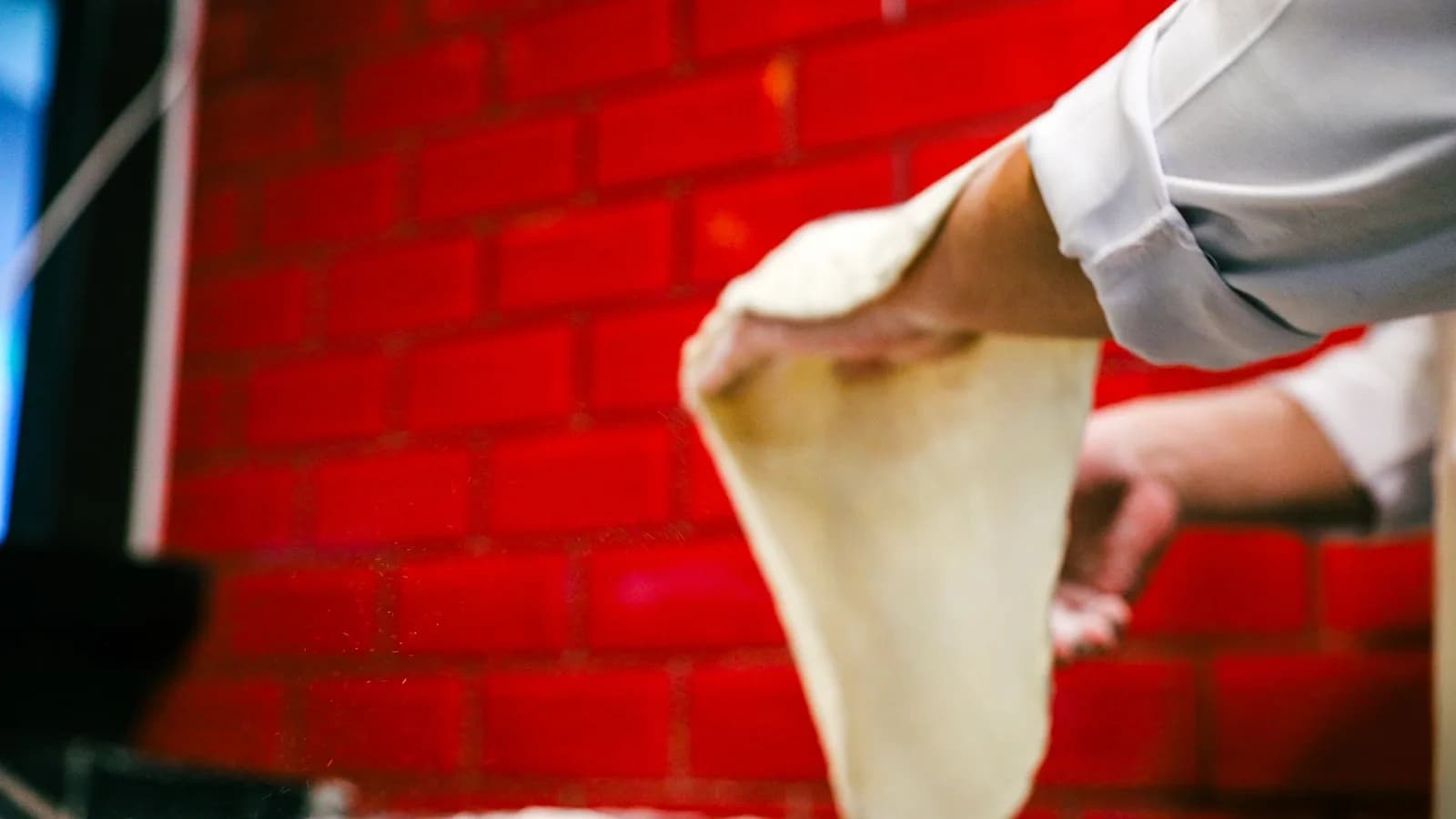
Hand-stretched pizza dough tastes better because it is shaped by hand from slowly fermented dough, which keeps the air pockets that give a base its puffy rim, chewy middle and proper crunch. Once you have eaten the real version, the machine-pressed and frozen-disc pizzas never quite work again. The crust is the thing. Here is exactly how we make our hand stretched pizza dough at Kebys in Great Barr, why it matters, and what is actually happening when a pizza chef turns a ball of dough into a base.
What does hand-stretched pizza dough actually mean?
There are three common ways a pizza base gets made, and only one of them earns the name.
- Frozen disc, thawed and topped. A pre-formed dough disc is frozen, thawed on demand and topped. It is the cheapest method. The result is dense, slightly flat-tasting and short on air structure.
- Pressed dough. A ball of dough is machine-pressed flat in seconds. It is faster than hand-stretching, but the press crushes the air bubbles that build up during fermentation. The base ends up uniformly thin and a little tough.
- Hand-stretched. A rested dough ball is shaped by hand, pressed gently in the centre to leave a thicker rim, then coaxed outward at the edges. It is slower, but it protects the air bubbles. The base finishes thin in the middle, puffy at the rim, with real structure.
We use method three. Every order, every shift. That is the difference between a base that carries toppings and a base that is genuinely good to eat on its own.
How is our dough made, from mix to bake?
Good dough is mostly patience. Here is the full run at Kebys, morning to plate.
Step 1: Mix, before service
Every morning we mix a fresh batch. The recipe is deliberately plain:
- High-protein bread flour (around 12 to 13% protein). Strong flour builds the gluten network that gives the dough its strength and chew.
- Water at about 65% hydration of the flour weight.
- Salt at 2% of flour weight, for flavour and to control the yeast.
- Yeast, a small amount, slow-acting for a cold ferment.
- Olive oil, a touch, for flavour and a softer crumb.
It is mixed for roughly 8 to 10 minutes: long enough to develop the gluten, short enough that the dough does not overheat. If you want the science on why kneading turns loose flour and water into a stretchy, elastic dough, the Wikipedia entry on gluten{:rel="noopener noreferrer" target="_blank"} is a clear read.
Step 2: Bulk rest
The mixed dough rests at room temperature for about 30 minutes. That kicks off fermentation without letting it over-prove before it hits the fridge.
Step 3: Portion into balls
The bulk dough is divided into individual balls, sized for 9", 12" and 16" pizzas. Each ball is shaped tight and set in an oiled tray so it holds a clean, round shape.
Step 4: Cold ferment, the part that matters
The trays go into the fridge for 8 to 12 hours. This is where dough stops being a mix and becomes itself.
A slow cold ferment does three jobs at once:
- Slows yeast activity, giving flavour-developing enzymes time to work.
- Strengthens the gluten gently, without the overworking you get from a rushed, warm rise.
- Builds flavour as the slow ferment produces the lactic and acetic acids behind a properly fermented dough's faint tang.
You cannot shortcut this. Dough mixed and used the same day tastes flat. Dough rested overnight tastes alive. Every batch is made and stored to Food Standards Agency guidance{:rel="noopener noreferrer" target="_blank"}, so slow does not mean risky.
Step 5: Bring back to temperature
About an hour before service, the dough balls come out of the fridge to warm to room temperature. Cold dough fights back and tears; room-temperature dough stretches like it wants to.
Step 6: Stretch to order
When your order lands, the chef pulls a ball, dusts the wooden board with flour and shapes it by hand:
- Press the centre. Finger-pressed flat, leaving the outer 2cm thicker for the rim.
- Lift and stretch. Gently pulled outward at the edges and rotated to hold the round.
- Final shape. Landed on the peel, a touch more oval than perfect. That slight imperfection is how you know it was stretched, not pressed.
The whole stretch takes 30 to 40 seconds and never comes out of a machine.
Step 7: Top and bake
Sauce, cheese and toppings go on in seconds, then into the oven. It comes out 6 to 8 minutes later, depending on size, with a puffy rim, a dark-flecked underside and a centre that is crisp but chewy. If you want to see the whole spread that lands on this dough, our tour of the Kebys pizza menu walks through all 13 pizzas across three sizes.
Why does hand-stretched pizza dough taste better?
Because the flavour and the texture are both built in, not added on. Bite into a hand-stretched, slow-fermented pizza and four things happen at once:
- The rim puffs up around the bite. That is the air you preserved by stretching instead of pressing.
- The base bends slightly without falling apart. That is properly developed gluten doing its job.
- The bottom shatters cleanly. That is heat meeting dough that actually had structure.
- There is a faint tang on the swallow. That is the slow ferment talking.
Compare a frozen-disc pizza. The rim barely exists, it is just thicker dough. The base is uniform all the way through. It either bends without any snap or breaks into hard fragments. And the flavour is one note: bread, salt, finished. Neither is "wrong", but once you know the difference you cannot unknow it. This is the same slow-versus-shortcut thinking behind our slow-roasted Cypriot lamb doner too. Do the careful version, not the fast one.
Slow-fermented dough sits in a long tradition. The history of Neapolitan pizza{:rel="noopener noreferrer" target="_blank"} is essentially a history of patient dough and hot ovens, and our approach borrows the same principles even though we are our own thing.
How can you tell a hand-stretched base from a pressed one?
You can spot it before you even taste it. Look for these tells:
- An uneven, slightly oval shape. Perfectly round usually means a machine or a mould.
- A raised, bubbled rim. Hand-stretched dough traps air at the edge; pressing flattens it.
- Char spots, not uniform colour. Real dough in a hot oven blisters unevenly.
- A base that folds without cracking. Structure from the ferment, not stiffness from a frozen disc.
Then the taste test settles it: chew, a little tang, and a rim worth eating rather than leaving on the plate. For the full story of how we do this locally, read what makes Kebys hand-stretched pizza different in Great Barr.
Where can you get hand-stretched pizza in Great Barr?
Right here. Kebys is at 3 Bowstoke Road, off Newton Road, Great Barr, Birmingham B43 5EB, five minutes from the Scott Arms with free parking outside. We are open Tuesday to Saturday 4pm to 10pm and Sunday 3pm to 8pm, closed Monday.
Prefer it brought to you? The delivery apps carry our hand-stretched pizza across Great Barr, Perry Barr, Kingstanding, Hamstead, Pheasey, Streetly, Sutton Coldfield, Erdington and Handsworth through Uber Eats, Just Eat and Deliveroo. For collection, order online at kebys.co.uk, or find us on Instagram at @kebysuk{:rel="noopener noreferrer" target="_blank"}. New to us? Start with our guide to Kebys in Great Barr for the full lineup.
The dough station is visible from our order counter, so if you pop in during service you will see the pizza chef stretching the next order in real time. It is not a marketing line; it is just how the kitchen is built.
FAQs
What does hand-stretched pizza dough actually mean?
The base is shaped by hand from a ball of risen dough, not pressed flat by a machine or thawed from a frozen disc. The hand-stretch preserves air bubbles, giving the base its proper structure.
Why does hand-stretched dough taste better?
The slow ferment (8 to 12 hours rest) develops flavour and structure that fast-mixed dough cannot match, and the hand-stretching preserves the air pockets that give a pizza its puffy rim and chewy interior.
How long does the dough rest before use?
We mix fresh every morning and cold-rest for 8 to 12 hours before service. The fridge slows yeast activity, lets the flour fully hydrate, and develops the tangy character of a properly fermented dough.
Is the dough the same as Neapolitan pizza?
Similar principles, slightly different specs. Our oven runs hot but not the 450C of a wood-fired Neapolitan setup, and our hydration is slightly lower to suit our oven type.
Can I see the dough being stretched at Kebys?
Yes. Pop into the shop at 3 Bowstoke Road, Great Barr during service, Tuesday to Saturday, 4pm to 10pm. The dough station is visible from the order counter.
Do you deliver hand-stretched pizza near me?
Delivery through the apps covers Great Barr, Perry Barr, Kingstanding, Hamstead, Pheasey, Streetly, Sutton Coldfield, Erdington and Handsworth via Uber Eats, Just Eat and Deliveroo, plus collection from B43 5EB with free parking outside.
Written by
Kebys Team
Stories from the Kebys kitchen, Great Barr
Share this article