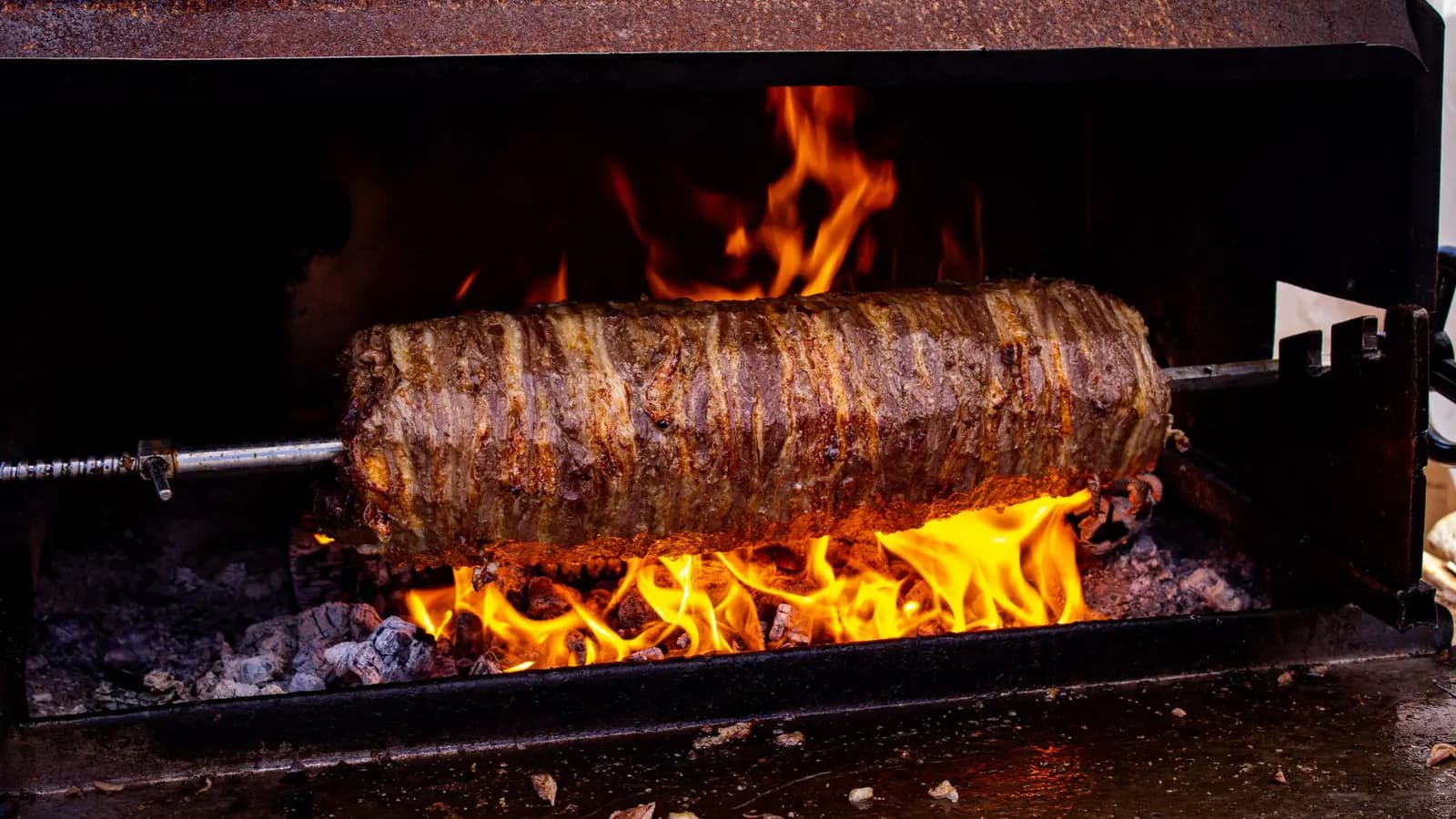
The doner kebab began as a 19th-century Ottoman innovation, and the version you order today is the result of roughly 160 years of tweaking. A meal as everyday as a doner has a longer story than you would expect. The vertical spit, the slow-roasted seasoning, the bread-and-salad format, none of it was invented in a 1980s British high street. Properly understood, the history of the doner kebab stretches back to 1860s Turkey and beyond. Here is the short version, plus why the lamb we use at Kebys in Great Barr is sourced from Cyprus.
Who invented the doner kebab?
The vertical-spit cooking method, meat stacked upright, rotated past a heat source, shaved off as it cooks, is widely credited to İskender Efendi, a chef in Bursa, in what is now modern-day Turkey, in the 1860s.
Before İskender, most kebab traditions were horizontal: chunks of meat on a flat skewer over coals, what we would now call shish or şiş. The breakthrough was reorienting the meat vertically. The benefits were immediate:
- Self-basting: fat from the upper layers melts down through the lower layers as the meat turns
- Even cooking: the outer edge chars while the interior stays moist
- Continuous service: slices are carved off as the meat cooks, exposing fresh meat for the next round
İskender's restaurant in Bursa still operates today, and the dish that bears his name, İskender kebab, doner slices over flatbread with yoghurt and tomato sauce, remains a Turkish classic. You can read the fuller cultural background on the doner kebab entry on Wikipedia{:rel="noopener noreferrer" target="_blank"}.
The word itself is a clue. "Döner" comes from the Turkish verb dönmek, meaning "to turn". So a doner kebab is, quite literally, a turning kebab. Everything about the modern dish grew out of that single idea.
How did the doner become a British takeaway staple?
The doner's journey from Bursa restaurant to British high street runs through Germany. The dish as global street food owes a huge amount to Turkish immigrants in West Berlin in the 1960s and 70s.
As Turkish workers settled in Germany under the Gastarbeiter (guest worker) programme, several cooks reimagined the dish for eating on the move. The most famous is Kadir Nurman, who opened a stand near Berlin's Zoologischer Garten station in 1972. The innovation was simple and brilliant: stuff the shaved doner meat into a folded flatbread or pitta with salad and sauce, and you have a one-handed, walking-around meal. Fast, filling and cheap.
Berlin's doner stands multiplied, the format spread across Europe, and it reached Britain through similar diaspora routes. Doner kebabs arrived here on the late-night takeaway tide of the late 1970s. By the 1980s and 90s, the kebab shop was a fixture of the British high street: open later than the chippy, hot, filling and well-priced.
The food itself, though, took some knocks along the way. Supplier shortcuts crept in: lower lamb percentages, more rusk, sweeter seasoning blends. The 60 to 70 percent lamb mix became the trade standard, and the result was a homogenised "British doner" that bore only a passing resemblance to what İskender Efendi was carving in Bursa.
The good news is that a wave of independent kebab shops through the 2010s and 2020s has pushed back: higher lamb percentages, traditional seasoning, slower roasting. We are firmly part of that wave. If you want a checklist for spotting the difference, our guide to what makes a great kebab shop walks through the signs worth looking for.
It is worth remembering just how big the doner became in Britain. It is now one of the most-ordered late-night takeaway dishes in the country, sitting alongside fish and chips and the curry house as a genuine national institution. That popularity is exactly why quality slipped for a while: when demand is huge and margins are thin, the temptation to bulk out the meat with rusk and cut the lamb percentage is real. Getting back to a proper doner means resisting all of that, which costs a little more and takes a little longer.
Why does Kebys use Cypriot lamb?
We use over 90% Cypriot lamb in our doner. So why Cyprus specifically?
Cypriot sheep farming has characteristics that suit doner production particularly well:
- Pasture-raised on Mediterranean herbage, wild oregano, thyme, rosemary and sea-spray-touched grasses
- A varied coastal climate, cooler in the north and warmer in the south, giving the meat a developed flavour profile
- Smaller, traditional farms rather than intensive grain-feed operations
- Mature animals, properly grown rather than rushed to slaughter weight
The result is lamb with a more developed flavour than grain-fed equivalents. When you slow-roast it on the spit, the fat renders into the muscle and bastes the meat from the inside out. Lamb is also a genuinely nutritious choice: it is a good source of protein, iron, zinc and vitamin B12, as the NHS notes in its guidance on meat in the diet{:rel="noopener noreferrer" target="_blank"}.
The slices that come off our spit have:
- Proper outer char from the spit's heat element
- A pink, tender interior from the slow rotation
- A clean lamb flavour that doesn't need masking with sugar or excess seasoning
We add only salt, pepper, garlic, oregano, cumin and the water needed to hold the spit together. No rusk. No mystery starches. If you want the full story on our sourcing and the taste difference it makes, we go deeper in our piece on the best lamb doner in Great Barr.
How is a doner spit cooked?
The doner spit is not a microwave. It is closer to a slow-roast oven that runs continuously through service:
- Stacking the spit, usually done at the start of the day. Marinated meat is pressed tightly onto the vertical pole, building up to 30 to 50 kg depending on the shop's size.
- Heating, a vertical heat element, gas or electric, sits to one side. The spit rotates slowly past it.
- Slow rotation, the spit turns at a steady speed. The outer edge cooks while the inner core stays raw, gradually exposed as the outer layers are carved.
- Service, a long, sharp knife shaves thin slices off the outer cooked edge, exposing fresh meat for the next round.
A spit needs proper time. Ours starts service at 4pm, and by 10pm what comes off the blade is the result of six hours of basting, browning and tenderising. There is no way to shortcut it, which is exactly why a 4:15pm doner tastes a little different to a 9:30pm one. Both are good, just different.
Food safety matters as much as flavour here. Doner spits are handled under Food Standards Agency guidance to make sure the meat is cooked through and stored correctly, something you can read more about via food.gov.uk{:rel="noopener noreferrer" target="_blank"}.
What other kebabs are related to the doner?
The doner has cousins across the old Ottoman world, and they are worth knowing. Our beginner's guide to kebab types covers what we serve, but here is how the wider family fits together:
| Kebab | Origin | What sets it apart |
|---|---|---|
| Doner | Bursa, Turkey | Vertical spit, thin-shaved, usually lamb or a lamb blend |
| Shawarma | Levant | Same vertical spit, spiced with cumin, cardamom and allspice, served in a wrap |
| Gyros | Greece | Vertical spit, often pork in Greece, served with tzatziki |
| İskender | Bursa, Turkey | Doner slices over flatbread with yoghurt and tomato sauce |
| Shish | Turkey | Chunks on a horizontal skewer, older than the doner |
| Adana | Adana, Turkey | Hand-minced lamb pressed onto a wide skewer |
They share one common ancestor: cooking meat slowly beside a fierce heat and shaving or carving it to order. The doner just happens to be the version that conquered the British high street. Each version reflects the herbs, meats and breads of its home region, which is why a Greek gyros with tzatziki tastes worlds apart from a cumin-heavy Levantine shawarma, even though the cooking method is nearly identical. Understanding the family tree makes it easier to order what you actually fancy, rather than defaulting to the first thing on the board.
Where can you taste it in Great Barr?
The headline order is the Lamb Doner at £7.79 in a pitta, the same spit, the same Cypriot lamb, and the same traditional seasoning this whole article has been about. It is £8.29 in a naan, £9.29 with fries, or £7.99 as a Rice Box. If you want to taste some variety alongside it, the Mixed Meat (£7.99) pairs lamb doner with chicken tikka in one wrap.
Kebys is at 3 Bowstoke Road, off Newton Road, Great Barr, B43 5EB, open Tuesday to Saturday, 4pm to 10pm, with free parking outside. If you are new to the neighbourhood, our welcome guide to Kebys in Great Barr covers everything on the menu. We also deliver across Perry Barr, Kingstanding, Hamstead, Pheasey, Streetly, Sutton Coldfield and Erdington through Uber Eats, Just Eat and Deliveroo, so a century and a half of kebab history can land on your table tonight. Prefer to collect? Order online at kebys.co.uk, or find us on Instagram at @kebysuk.
Written by
Kebys Team
Stories from the Kebys kitchen, Great Barr
Share this article